Foreward by Cameron McNeish

"It’s the sort of long distance route that most keen walkers dream of. A long tough trek through some of the most majestic, remote and stunningly beautiful landscape you could dare imagine."

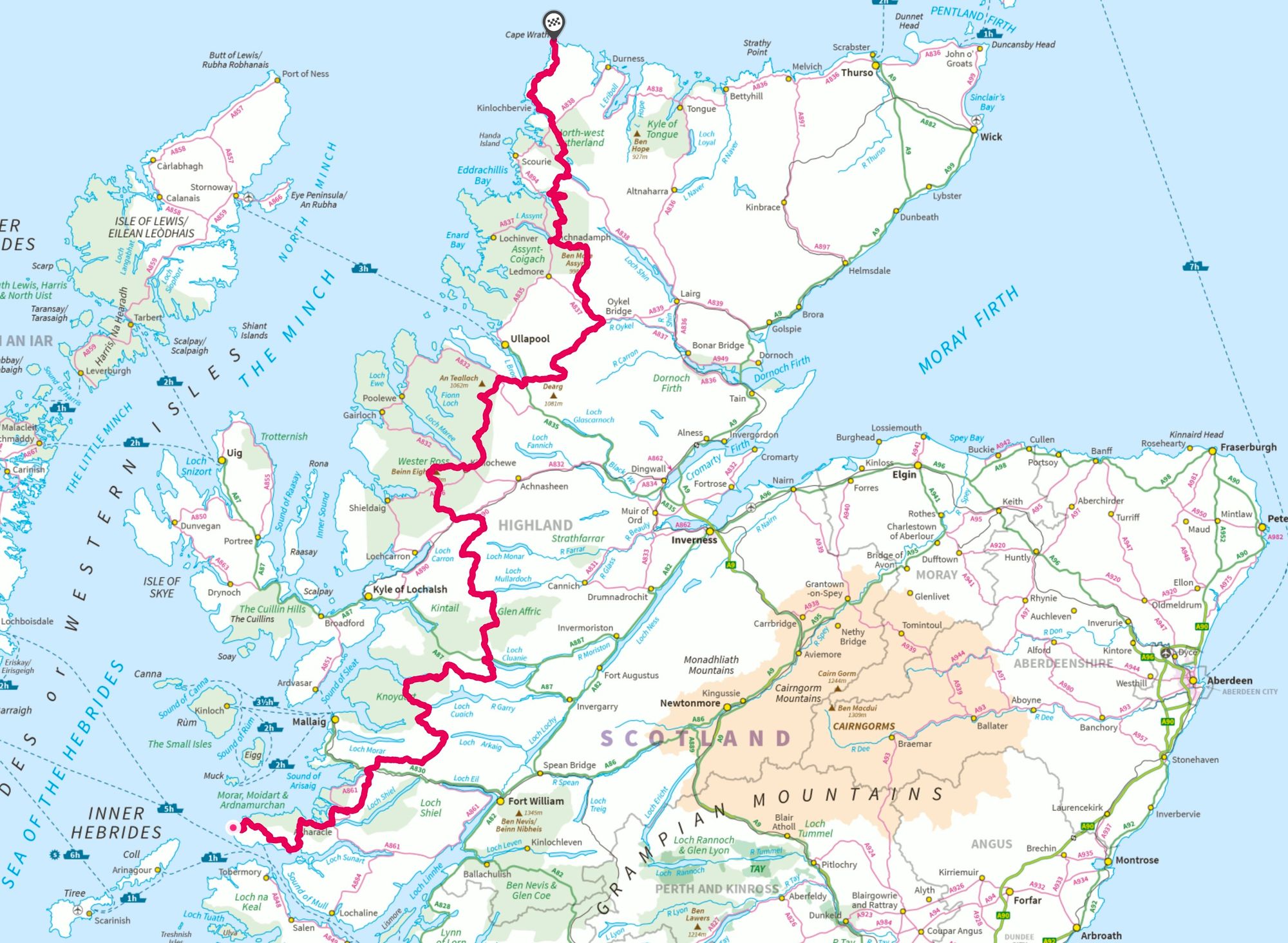
The Cape Wrath Long Distance Trail is just short of 200-miles long and runs from Fort William to the most north-west tip of the Scottish mainland, a challenging and often remote route which, in essence, could be described as the hardest long distance backpacking route in the UK. Various routes exist between Fort William and Cape Wrath one guide having been published, Denis Brook’s and Phil Hinchliffe’s North to the Cape, (Cicerone).

The route I’ll be describing largely traces the routes of the others but differs here and there because, being a passionate backpacker, I’ve never limited myself to choosing a route that is depended on hotel or hostel accommodation. Give me a lightweight tent with the scents of the wilds wafting through the door, and a lightweight stove and food so I can cook a meal or brew a cuppa whenever and wherever the mood takes me.

Having said that, in working out this route I gave myself several rough guidelines: the route should follow a south to north line as close as possible; it should allow passage through the most scenic areas; it should try and avoid tarmac and paved roads or paths but instead follow existing footpaths and stalkers’ tracks whenever they were useful and it should avoid crossing mountain ranges and major rivers except where necessary.

The final route is a stunner. It begins at Banavie, just outside Fort William, heads up the Great Glen to Loch Lochy and then turns north to cut across Glen Garry and Glen Shiel. It traverses the huge, empty quarter between Glen Shiel and Strathcarron, wanders past the mountains south and north of Torridon and the great wilderness between Loch Maree and Little Loch Broom. North of the Ullapool road the route traverses inland to Oykel Bridge then begins the wildest and remotest stretch of all – through the mountains of Inchnadamph and Kylesku, below the shadows of Arkle and Foinaven to Rhiconich, then to Kinlochbervie on the west coast. With a final flourish we hike over the moors to magical Sandwood Bay and the remaining cliff top walk to Cape Wrath Lighthouse, the end of the journey.

The first section of the route eases you in gently, from Fort William to Banavie and the flat towpath of the Caledonian Canal and the route of the Great Glen Way (that runs for 73 miles between Fort William and Inverness). The Great Glen Way follows the 400 million year old geological fault line that crosses Scotland between Inverness and Fort William, with Loch Ness, Loch Oich and Loch Lochy almost making an island of northern Scotland. These three lochs are linked by Thomas Telford’s Caledonian Canal, a man-made waterway that allows vessels to navigate between the North Sea and the Atlantic. The route of the Great Glen Way, Scotland’s fourth National Trail (The West Highland way, the Southern Upland Way and the Speyside Way are the other three) jealously hugs the line of the canal and at other times breaks free to follow forest trails and minor roads, often high above the lochs and the forests that skirt them. Beyond Glengarry the mountains rise higher and steeper and you find yourself wandering amongst some of the finest landscapes imaginable. Enjoy the wild and lonely Glen Loyne between Glengarry and Glen Shiel, and soak up the atmosphere of the Fionngleann and Glen Lichd as they tumble down between the great mountain walls of Kintail.

Don’t miss the tumultuous Falls of Glomach, not quite the highest waterfall in Scotland but certainly the most impressive, especially after a bout of heavy rain. The top of the waterfall lies about a mile beyond the Bealach na Sroine, above Morvich on Loch Duich, and involves a descent of about 600-feet. As you drop down from the pass you’ll notice the sprawling strath of Gleann Gaorsaic and its various streams and burns that feed the main river, water courses that drain the slopes of big mountains like Beinn Fhada and the magnificently sculpted Sgurr nan Ceathreamhnan. All that water harnessed into a narrow steam and then directed into a narrow, rocky cleft where it plunges for some 400 feet, twice the height of Niagara, into a deep, black chasm. You’ll probably see the spray and hear the thunder long before you see the waterfall itself. Needless to say great care should be taken on the normally wet path that skirts the top of the falls.

Beyond Glen Elchaig you’ll find yourself in some of the loneliest landscape in Scotland as you tread the wild miles between Bendronaig and Bernais in the Attadale Deer Forest. These are landscapes for the wilderness connoisseur and if the suggested route looks too wild, then there is an easier, or bad weather, alternative.

A little word of warning though – the first three miles, from Fort William to Banavie, are grim and I would suggest walkers take a taxi to Banavie, at the start of the Neptune’s Staircase (canal locks) on the Caledonian Canal, and begin there.

I’ve described the route from Fort William for any purists who want to walk the whole route, but the route, following the official line of the Great Glen Way, is contrived and miserable, talking walkers along the back of Safeway’s supermarket, behind the shinty stadium, through of one of Fort William’s housing schemes, and along the filthiest bit of coastline I’ve ever seen.


Route Notes

accommodation/services